












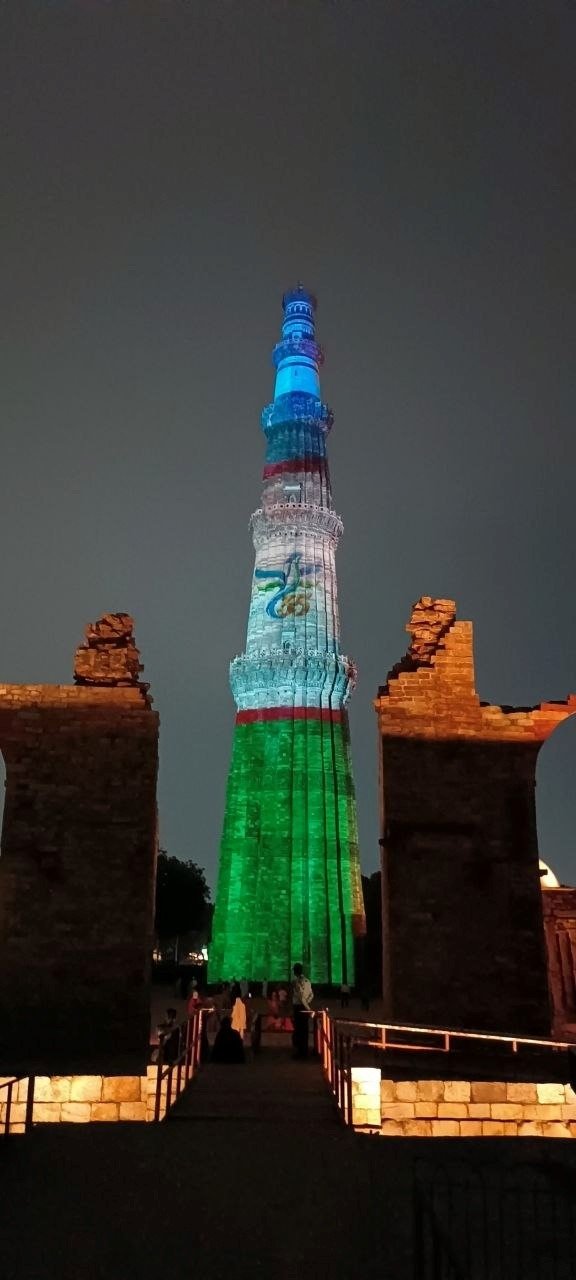
In a striking gesture of international camaraderie, New Delhi’s iconic Qutb Minar was illuminated in the vibrant colors of Uzbekistan’s national flag on September 1, marking the 35th anniversary of the country’s independence.
The spectacle highlights a rapidly deepening alliance between the two nations. India was among the first countries to recognize Uzbekistan’s independence on December 26, 1991, with formal diplomatic relations established in Tashkent on March 18, 1992. Over the past three decades, bilateral ties have evolved from traditional friendship into a dynamic, strategic partnership.
Today, cooperation spans across key sectors, including political dialogue, trade and investment, technological innovation, education, and cultural exchange.
Adding historic weight to this year’s milestone, Indian Prime Minister Narendra Modi paid a high-profile state visit to Uzbekistan on the eve of the independence celebrations. The top-level summit underscored a shared commitment to mutual respect and political trust, culminating in the formal elevation of bilateral relations to a Comprehensive Strategic Partnership.
Economic collaboration served as the centerpiece of the high-level discussions. Bilateral trade surged by 33 percent over the past year to reach $1.3 billion, with both leaders setting an ambitious target to scale trade turnover to $5 billion by 2030.
The visit also yielded a robust portfolio of joint investment deals, securing concrete agreements with major Indian enterprises. Key growth vectors targeted for future expansion include:
- Energy and critical minerals
- Healthcare and pharmaceuticals
- Electronics and heavy engineering
- Jewelry manufacturing and agriculture
The illumination of the 72.6-meter brick minaret—built beginning in 1193 under Qutb al-Din Aibak and designated a UNESCO World Heritage site in 1993—stood as a testament to the enduring cultural respect linking the two countries, serving as a symbolic celebratory tribute from the people of India to Uzbekistan.